
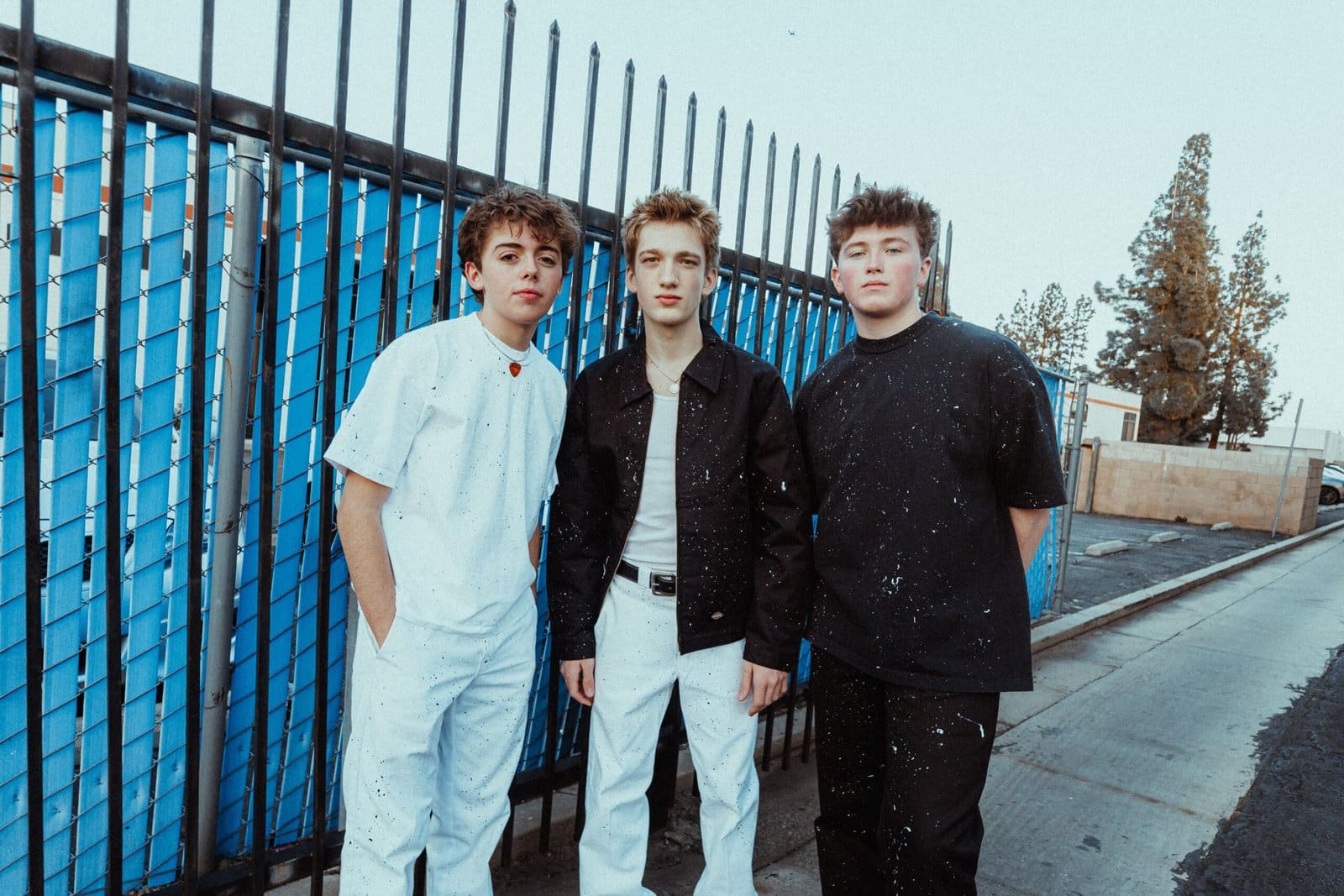
Carson Groves, Hyrum Russon and Shredder Winegar of Riff Wood might still be in their teens but they’re already releasing their sophomore album, Butterfly in Black and White. The Rob Cavallo-produced record draws from the band’s pop punk influences, combining Green Day-esque riffs with more melodic sounds for an album that is cohesive and had a depth that belies the young ages of the band’s members.
Atlas spoke with the trio about how the record came together, connecting with Cavallo and his family and looking towards the future of Riff Wood.
Atlas Artist Group: Can you tell your band’s origin story? How did Riff Wood come to be?
Carson Groves: All of us met towards the end of elementary school and we just became super tight friends and it wasn’t until a little bit later that we saw this show on Netflix called Julie and the Phantoms and it’s basically just about a band. We were like 11 or 12 and we were just like, we should do that.
We didn’t even really know how to play any instruments. None of us were very musically talented.
Hyrum Russon: Hey, I had some singing in my family.
Shredder Winegar: I played piano. I wasn’t good.
Carson: We had little to no musical talent and we sort of just claimed our instruments and our roles in the band. We just started learning some covers from some of our favorite songs and listened to some rock music and started writing songs and here we are.
Atlas: Where do you find your inspiration musically? What are some of your favorite bands?
Hyrum: When we first started, it was a lot of Green Day and a lot of pop punk bands like Blink-182, Yellowcard and stuff like that. Those other bands were maybe like 20 or 30 percent of it, but Green Day was most of it.
Shredder: Yeah, strictly Green Day.
Hyrum: We played a lot of Green Day covers and when we first started writing songs, we were mainly taking inspiration from Green Day as well. Then slowly these other bands started to creep their way in- like The Beatles- and then we started listening to Radiohead, Led Zeppelin, a lot of grunge bands and The Police and a bunch of these different bands.
Now our sound is progressing a little bit and even the songs we’re writing now have drastically changed from the songs we wrote on our second album that’s about to come out.
Shredder: I think the first one, you can really hear the Green Day influence, a little Blink maybe, but the second one, you can definitely tell we’ve been pulling from a lot more diverse bands.
Carson: It’s still got that sound that’s pretty consistent from the first record for sure but like Hiram and Shredder said, we’re just expanding. We’re listening to more artists. It feels like every few months we’re just into a new phase of a new band, you know? [We’re] just always listening to new stuff and just adding that to our own sound and progressing from there.
Atlas: You got to work with Rob Cavallo on this one, which is amazing. How did that come about- he found you, right?
Shredder: His son found us and then his wife reached out to us, which is our current manager.
Carson: His wife, Kim, reached out through a DM. I remember one night I was just scrolling through some of our DMs on the band account and I just saw the last name Cavallo. And I was just like, no, there’s no way.
All three of us are massive Green Day fans, like we’ve said before, and so I knew the last name Cavallo as soon as I saw it. I just didn’t know if it was legit or not. In the DM, she’s like, my husband [and I] have our new management company called Done Deal Management. You may know some of his work. I’m like, yeah, I do- who doesn’t know Rob’s work? My jaw was just on the floor for an hour once I read that. I showed it to the rest of the band and we hopped on a few calls with them and it was just instantly a perfect fit. They create such a great, safe and fun environment around us and we feel very comfortable. It’s just really fun and they’re great people so we’re super happy to work with them.
Hyrum: We later heard that- I mean, Rob’s such a legendary, big producer that when Kim, his wife, was showing him our songs, he’s like, you’re trying to show me a band of kids?
Shredder: She was trying to force it on him and in the car, she’d steadily play it.
Hyrum: At first he said, oh, it’s just a couple of kids. But then she played our music in the car when he didn’t know it was us and he’s like, who is this? She was like, it’s Riff Wood, that band I was telling you about. And he was like, okay, I’ll check them out. He liked our stuff.
Atlas: What was your creative process like in the studio for this album?
Hyrum: There’s the recording and then the writing. And for us- at least at this stage in the band- we write all of our songs before we go to record them and we had the entire album- or at least most of it. Ten of the 13 songs were written before we went into record and we had been spending a year and a half to write those songs.
That usually comes with a guitar riff first- at least for me. I think Carson’s is a little different, but usually it’s a guitar riff, and then a melody and then lyrics last. We take those songs [and] we work on them as a band.
Shredder: I think it’s very different, the writing process and the recording process. Sometimes bands go into the studio with three or four ideas and then they write the whole album in there. Rob will help with that, with a lot of bands. But for us, we came in with the full album.
Hyrum: It’s more about just bringing our sound out.
Carson: Rob does a really great job of capturing our raw and authentic version of the songs, while also elevating it to a higher level. Most of the songs on this record, we didn’t really change at all. We wrote them and went to the studio and they’re pretty much the exact same song as when we wrote them before- except Rob will add things.
One of our songs is called “Down to Nowhere”- it was originally just clean guitar and an intro with vocals or something. But then we added strings and there’s flutes and the Mellotron that got the flutes and the string sound. It just made it so much better, it just brought it up.
Shredder: He just elevates everything.
Carson: He captures the sound and then makes it better.
Atlas: From the 13 songs on this album, are there any that you find yourselves very strongly connected to? What are you hoping your fans will take away from the record?
Carson: I think in a way, we’re all really connected to the songs on the record, whether it’s that the lyrics connect to us or just something that the melody just sits nice in your brain. I think every song on this record, we’re very connected to it somehow. There’s definitely some that are more than others.
I think for me, there’s a song called “Manufactured Tragedy”. My friend Dan came up with that title and he just told me, you should write a song about that and so I wrote the entire song based off of that title. It’s just about how we all sometimes struggle to find the positives amidst all the negative things around us and I think everyone on this planet can relate to that at some point. That song makes me feel good and hopeful about things.
Hyrum: I think I connect a lot to the lyrics of “Beyond a Tree” because that was a personal experience for me and I also connect with the entire song as a whole of “Butterfly in Black and White”. I love that one.
Shredder: For me, it’s different. I’ll rarely connect to the lyrics. Sometimes I will. I’ll learn a lyric later and be like, oh, who wrote that? That’s actually pretty good. For me, the mood I’m in changes how I hear certain songs. So when we’re playing live, I’ll maybe enjoy “Butterfly”, the next night, I’ll really enjoy “Manufactured Tragedy”. I think it’s just whatever mood I’m in finds a different part of the song.
Atlas: You’re a Utah-based band- what’s your music scene like and how do you fit into it?
Hyrum: People don’t really do that much pop punk or alt rock.
Shredder: Ours is a lot of indie coming out of Utah.
Hyrum: There’s a lot of bands and they’re usually indie rock. They’ve got a Backseat Lovers kind of sound. It’s a good music scene and people like to go to concerts here.
Carson: There’s a few venues that people go to all the time. There’s this venue called Kilby Court- there’s always shows going on there and I’ve been to a bunch there.
Hyrum: We didn’t even know about any sort of local music scene when we started. We were 11 or 12 and we didn’t really know about it. We were just like, we want to start a band. I think the time when we first realized there were a lot of other bands is when we did Battle of the Bands for our state and we were seeing all these other bands and we were like, wow, we’re not the only one.
Shredder: I think we were blessed though with a really active music scene. There’s always something going on.
Carson: The fact that they were even able to put on a Battle of the Bands- if there weren’t enough bands to do it, then you wouldn’t be able to do it. That was a very important thing for us. It was really the turning point in this band that gave us the idea that we can really turn this into something great and that we should keep running with it.
Atlas: You’re really just getting started- there’s so much ahead for all of you. What are you looking forward to in the future? What are some of your goals as a band?
Carson: Just progressing and getting better and always trying to be proud of what we’re working on because at the end of the day, you’re really just going to enjoy it the most if you’re keeping it interesting and you’re getting better each day.
It’s definitely good for the fans to have that happen as well. The feeling you get when we sing our songs to people and they sing them back to us- it’s just such a great, surreal feeling. The bigger the room, the better the feeling for everyone. It’s such a magical feeling and so expanding that to even more would just be amazing.
Atlas: Is there anything else that you want people to know about you or your music or is there anything that you wish you could talk about more that people might not ask you?
Shredder: Well, first off, the album is coming out this Friday, September 18th. Give it a listen. We are proud of it. We hope you like it.
Hyrum: I wish people would ask us more about the stories of how we wrote specific songs. I don’t think anyone’s asked us the process of how we wrote “Blur”.
Carson: Feel free to ask us anything! That’s my message. We’re open books!
Stream Butterfly in Black and White, out now!
The interview has been lightly edited for length and clarity.
