
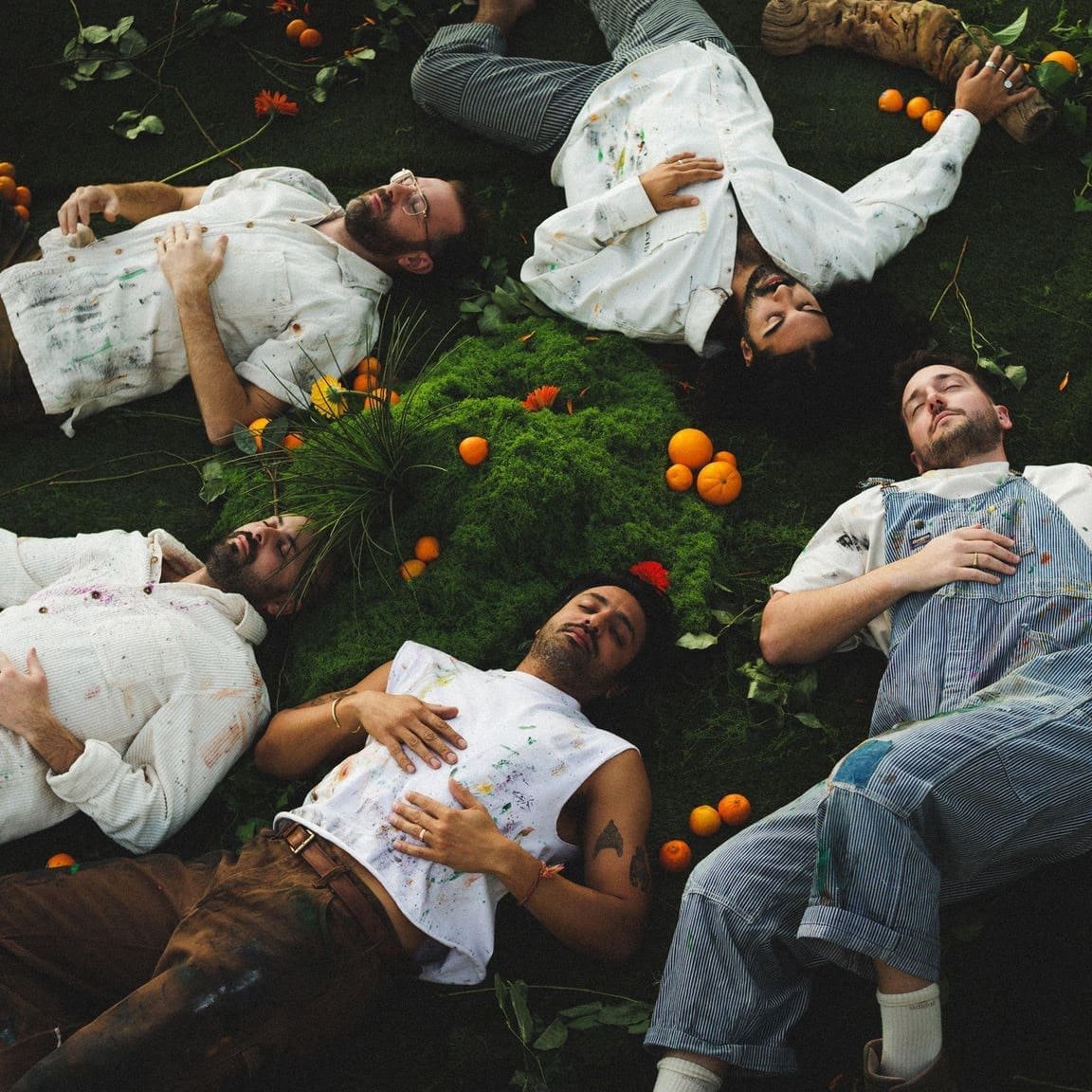
Young the Giant has returned with their stunning sixth album, Victory Garden. The band returned to the studio for their most collaborative and connective album yet, citing it as an ode to radical empathy- a sentiment woven deeply into every song. Atlas spoke with guitarist Eric Cannata about the creative process for the album, bringing these songs to life this summer and much more- check out our interview!
Atlas Artist Group: The first thing we read was that this album is an ode to radical empathy, which is a wonderful sentiment. What does that mean to you as a band and how did it inform the creation of this record?
Eric Cannata: Radical empathy to us- this record’s a lot about the idea of love over fear, life over death, trying to break through the walls that we’ve created as we get older into our adulthood. Besides myself, everyone else in the band has young children so a lot of this record was really inspired by viewing the world from that lens- viewing the world from the lens of a child.
I think that’s something that comes from the lens of a child is empathy and pure love and being present. Right now, we as a band, and just echoing out into the general human race, it feels like really yearning for getting our humanity back, building community, being together in person. And I think that radical empathy is a form of its own resistance.
Art is a form of resistance and being able to be trying to find that within ourselves as a band, to give each other more empathy and then bring that on the road and try to bring that feeling of that kind of difficult love- right now, it’s such a polarizing world that we’re living in. I think that we realized that internally, that’s what we were looking for and I think that’s what we were really writing about.
I think that some of the greatest leaders in history led with love and that’s something that we admire and I think that that’s something that is more powerful than fear. It’s like that billboard behind Bad Bunny at the Super Bowl- I think it said love is the only thing more powerful than fear. That’s echoing in the zeitgeist right now- I think we’re all looking for that.
Atlas: Your music over the years has really echoed that sentiment through so much of your material. Did it feel like a natural progression when you were making this record? Did it feel like something that was just supposed to happen?
Cannata: Yeah, I think a little bit in the sense that we had all gone through the pandemic but we just naturally felt a desire to be together in the same room to write all together, to record all together, record as much live as possible to capture the energy of everyone in the room.
After the pandemic, doing a lot of things- I don’t want to say piecemeal- but a lot of times there was almost like a postal service type writing situation where we’d each be in our own little studio home studios sending each other ideas. We wanted to really get back to the roots of what the band was when we all lived together as teenagers and made our first record. It’s a little bit of a return to form in that sense, except we’re six albums in and have been doing this for a long time.
I do think it was just in the spirit of really trying to be present with each other and figure out where we’re at right now in our lives. We really did want to make something really all together. I think something that people say about our band is that when they see us live, they tend to think they could feel the energy more so than our studio recordings and I think this record is maybe the closest we’ve gotten to capturing that live energy in a studio recording. I love to hear that you feel that energy because I do think of things in the terms of energy and when getting on stage, the best case scenario is that as an individual and as a band, we’re trying to exude that energy and that feeling of belonging to the fans and the feeling that they belong there with us and we’re all together in it.
Atlas: Do you approach making music with building the story and the lyrics first or does the instrumentation come first and the lyrics follow? How do you approach the creative process in the studio?
Cannata: So this record has been probably the most collaborative- we were all in the studio writing together [and] we did four writing retreats over a span of about a year. We went to Joshua Tree out to the desert outside of Los Angeles for two of them, and then two of them, we went to the mountains in Idyllwild, California.
I would say that with this particular record, the musical idea would start with someone coming up with what we call maybe a spark- something that gets the ball rolling in the studio. It could be more of a traditional singer-songwriter style, where it’s a piano and a vocal melody or it could be completely an instrument- a pulsing synth bass or a drum beat, something that triggers a momentum in the studio and we start bouncing off each other.
And then a few of us in the band are more on the lyric and vocal side of things and we’ll start diving into melodies and lyrics and concepts. Sometimes the music will inform- this music makes me feel like this idea that I have that I want to talk about or it might just be what I would call translated gibberish, where the music informs melody and we might record a scratch melody over the music. Then it’s almost like the words start appearing from that gibberish and start telling you where it’s going.
It might not even make sense- it might never make sense, really. Some of my favorite songs we’ve ever written- and some of my favorite songs that some of my favorite songwriters have written- sometimes they’re like, I know what this makes me feel and I can tell you where the intention and the emotion around it was, but I can’t tell you exactly what this is about. It might be for the listener to make their own meaning from it. So it comes from many different ways. This particular record was super collaborative. We’re all in the room. We’re all like kids in a sandbox throwing ideas at each other and it was a blast. It was an absolute joy to make this record.
Atlas: Now that you’re going to head back on the road again for this album, which songs are you most excited to play?
Cannata: Oh, that’s a great question. We’ve been playing a few of the new songs recently, like you said, and I love everything we played. I am excited to play some of the songs we’ve yet to play. That includes a song called “This Too Shall Pass” and a song called “Are You With Me?”, which is one of my favorites on the album. I feel like it might be considered deep cut territory, but I tend to really like the moodier, deeper cuts. “The Garden” is another song but out of the songs we’ve played so far, I would say “Evergreen”. I love performing “Evergreen”, love “Different Kind of Love”. Every song we’ve played so far- “Ships Passing” is one of my favorites as well. So that’s my answer of basically saying all of them.
Atlas: Is there a particular song or songs on Victory Garden that you find yourselves particularly connected to as a band?
Cannata: I really think that most all of the songs feel so close to our hearts. There’s a general consensus that certain songs hit certain emotions for all of us.
I think “Ships Passing” is one of those songs. In terms of where we’re at as a band, and really a lot of what we were discussing when we started making the record, one of the first songs we wrote was “Bitter Fruit”. That struggle in the desire to shake off the mud of being an adult and just get back to the joy and the empathy we have for each other and the love we have for making music together.
That one’s really close to our hearts, especially with all the guys having young children, I have young nieces and nephews so just the inspiration- actually, when we wrote “Bitter Fruit”, it was out in Idyllwild in the mountains with our dear friend John O’Brien.
He has a studio out in the mountains and he has twin daughters. When we were writing “Bitter Fruit”, when we were writing the lyrics to the chorus- “I want to laugh and cry just like a child again”- we were right at that chorus, trying to figure [it] out and his daughters walked into the control room as we’re writing the lyrics. We just saw them and they just smiled and it was like, just like a child again.
It was one of those cool moments in the studio where they literally just inspired lyrics out of us by coming into the room because they love coming into the studio and playing around and they have their own little band. That was a song that really kicked off one of those major themes for the record in terms of viewing the world through the lens of a child.
Atlas: The record is out and the tour is coming up but are you looking past that? What’s coming up next for you?
Cannata: We’re really focused on this record and the tour and after that, we’re looking at international. Not to spill it before it’s announced but looking at the UK and Europe- we just went there for a couple weeks recently.
It’s looking like the fall for that and then we would love to do Central and South America, we’d love to do a little bit more international touring. And then get back to writing and recording more material. We’re feeling really inspired. We loved how we wrote this most recent record. We love the producer, he was super inspiring to work with. We’re all looking forward to doing more writing retreats. It almost feels like more fun than it’s ever been, which is nice for our sixth album.
Atlas: Is there anything else you wish you could talk about more that people might not ask?
Cannata: That is a great question. I would say that maybe it’s not necessarily something that someone could ask us but something that I think is important for me is that when we wrote this album, it came from a place of really desperately wanting to feel alive and feel emotions. The bombardment of bad news and AI and cell phone addiction, cell phone addiction- which is real for me and so many people. I’m excited to come out on the road and perform these songs so I can talk to people who come to our shows and make connections with the people who are listening to this music because I feel like there’s so many similarities between all of us- more similarities than there are differences. I feel like the more we can get off of that screen, that’s the reminder we’re trying to spread with this record. I just want to say that I feel so grateful and honored to have met such amazing people who come to see us perform. I’m just excited to be around that energy and hopefully people will feel that from our shows.
Stream Victory Garden, out now, and catch Young the Giant on tour this summer!
